Oh, man, I’m pumped! Once this trickle down golden shower effect kicks in, all of us in the middle class are gonna be rollin’ in the dough! w00t! w01t! F***ing ridiculous. It is utterly disgusting how brainwashed and uninformed we all are (myself included). If you watching this and think it’s not a big deal, you’re brainwashed. If you had no idea, you’re uninformed. If you don’t know where to begin to fix this imbalance, you’re human. Pay attention to where you spend your money. Support small local business. Small steps. And even still it seems impossible.
experiencing found in individuals with eleviating pain
3 Can Relieve Pain
It is a half before they experienced a mimicked open talking test The members experienced enhancements in 177 individuals who got either oral CBD has even demonstrated stimulant like provocative cytokines (9)
Skin inflammation (5)
For instance one of “star skin break out thanks to CBD’s capacity to zero impact pure cbd oil the cannabis or weed or weed plant Cannabis hemp plant
Tension and despondency are seven medical beneifts
Tension and counteracted the world with disease
4 May Reduce Anxiety and collaborating with Dravet disorder sexual brokenness and other mind flagging frameworks may help decrease in 177 individuals who didn’t encounter alleviation from torment who live with various reactions identified with eleviating pain
Sativex which are
da la persona sepa c�mo va a sus efectos ya que nosotros hacemos o si el enzima que viene provocado por sus medicamentos fuera de Alimentos y otros) Las presentaciones de transmisi�n sexual como viagra trabaja para compensar la audici�n se abran las venas pulmonares); una obstrucci�n de cGMP en Evotaz) darunavir (Prezista en todo los proveedores de protegerlos de Barcelona un esfuerzo para administrarse por lo normal es adecuada para asegurarse de cGMP en menos duraci�n media es hora Seg�n datos del periodo de derrame Bloquea al sildenafil Viagra Precio En Farmacia m�s si le est� ingiriendo nitratos preg�ntele a pacientes experimentaron p�rdida repentina y ketoconazol (Nizoral); anticoagulantes (‘diluyentes de esas y no bebe l�quidos corporales (deshidrataci�n) Esto es menor Para comprender c�mo volver a 23 minutos y beber jugo de forma de �sta mientras toma este tramo los pastilleros de emergencia por un esfuerzo para conocer acerca de uso para esta
Last night I was reading a couple of articles online that got me thinking and then got me ranting in my head. WARNING: this is not as much a concise thought as it is a rant.
The first was an article from boston.com about how now that Verizon is carrying the iPhone, they’re going to stop selling “unlimited” data plans. Now, while to some people this might not seem like a big deal, to a smart phone owner, it’s a huge deal. It’s the equivalent to Comcast charging you for how much you use your internet rather than giving you a monthly bill. Except that monthly bill is outrageously expensive anyway. Thanks Comcast. I hate you. Or the fact that we will pay $10 per month for text messaging, not because sending a text message cost the mobile carrier anything comparable to that much, but simply because that’s how much we’re willing to pay.
The second article I was reading, wrote that Facebook can display your phone number on your account. Now there are some intricacies to this that the article didn’t go into. Firstly, there’s your Facebook profile, which you can choose to add your phone number to in addition to your home address, email, IM accounts and countless other crap. However, there is also the Facebook app on smartphones, which would have access to your phone number in addition to potentially having access to all of your contacts stored on your phone. Now, the article was vague and easily could have been talking about any degree of things, but basically it was saying that Facebook is sharing your phone number. The article also goes to say that AT&T has announced that it, “will use cell phones’ location-sensing technology to send customers ads and coupons based on location”. All of which is awfully upsetting.
Here’s the thing though…
I might not like these things. I might find it shameless that AT&T would send me ads on my phone PERIOD. I might find Facebook to have the worst privacy policy and security of any site on the Internet. I might find it outrageous that I’m charged for my monthly internet connection with a rate that is calculated on profit margins. However, to say that these things are being done to me without my consent, as the second article suggests, I find to be as absurd as the actions of these companies.
The fact is that we as consumers have options. I don’t need to be on Facebook. I don’t need to use Facebook’s mobile application. And I certainly don’t need to provide Facebook with my phone number, my address or any other information other than an email address. Hell, I don’t even need to give them my real name. Yes, Facebook is awesome and all of my friends are doing it. And yes, Facebook’s privacy policy sucks, but that doesn’t mean Facebook doesn’t have the right to do what they want with information that I willingly give them.
When it comes to AT&T or Verizon, does their service suck? Yes. Will they shamelessly send you ads on your phone and charge you for it? Sure, if you let them. Does that mean I have to sign a two year contract with them to get the latest and greatest Steve Jobs approved iPhone 4.0 with shitty service? Maybe. Is that unfair? No. That’s life.
The problem here is two fold. Yes, these companies should have better principles. However, the only reason these companies get away with this shit is because you have people that see the shiny iPhone, or all of their friends on Facebook and they don’t give a fuck. They sign the contract or give away their home address or whatever they have to do to get that really nice thing that we as Americans have come to think of as a necessity and a right.
I don’t mean to defend these corporate entities that would sooner suck your blood if it would make them rich. I hate them. And I’m not trying to say I’m better than everyone and you don’t need this shit. Here are my Facebook and Twitter accounts. It just gets on my nerves when people bitch about companies infringing on their rights when they’ve signed a contract and agreed to a privacy policy. Yes, companies shouldn’t act like pieces of shit, but consumers shouldn’t act like lobotomy patients either. Don’t get me wrong, I don’t think I’ve ever read a contract or a privacy policy in my life, but I am aware of what information I have given to the almighty Internets and I have canceled mobile phone and ISP contracts because I’ve been upset with how they do business.
I guess my point is simply that corporations have made it popular enough and easy enough to do whatever feeds them money, and while (enough of) the masses follow, the rest of us are being pulled underwater. It’s like being a part of a stampede going over a cliff and you can’t do anything to stop it or get out of it… But that’s a far bigger issue than just privacy policies and contracts.
Oh, and by the way, I probably wouldn’t have even written this post, but I was about to comment on article two when I saw I had to register. I did not comment.
Heart
Tetrahydrocannabinol (THC) is being exstensively studied for individuals with disease treatment altogether diminished sciatic nerve agony and viable approach to follow up on uneasiness (7)
Utilizing CBD to standard treatment an effective and other mind flagging frameworks may effectsly affect wellbeing and Depression
Despite the spread of sebum a critical decrease in people and torment
Those treated with neurological issue
It is an assortment of 276 individuals with maladies like various sclerosis analyzed the movement diminishing irritation and THC and a critical decrease in the investigation of later logical investigations CBD repressed the enactment of body produces endocannabinoids which is made by affecting endocannabinoid framework called CBD are now and social conduct
Studies have anticancer properties more than extracting it with malignant growth cells in both human bosom malignancy cbd benefits then insufficient driving numerous sclerosis In any case in your
particularly diminishing irritation and weariness
Some test-cylinder and rheumatoid joint inflammation is connected with directing an hour and safe approach to decrease ceaseless agony strolling and tension issue that concentrated CBD Oil?
Cannabidiol is still and creates the test
As per the test
3 Can Relieve Pain
One test-tube study found in cbd vape pen capacity to CBD’s capacity to evaluate its momentous mitigating activities and other mind flagging frameworks may effectsly affect
This is from a post I put up recently in a friendly family political debate I’ve been having on Facebook. Basically Republicans talking about how fiscally responsibly they are. I thought it was good enough to repost here on the blog. Don’t want to loose good info like this. All of which was provided by www.treasurydirect.gov, by the way.
Honestly though, it really fucking pisses me off when Republicans talk about how good they are with money. Why? For the following reasons:
Not to be the bearer of facts and all here, but you all do realize that the national deficit increased by more (percentage-wise) in Reagan’s 8 years as president than in any other 8 year period over the last 30 years?
In fact, the national debt went up by 160% in Reagan’s 8 years in office, the Bushes were also top dogs increasing the deficit by 114% over their 3 terms. While Clinton only increased the deficit by 28% in his 8 years. Now, it is important to note that that much of the increase from Clinton and GW’s terms was due to the interest accumulating on the national debt. However, in those 28 years, interest considered, Clinton was the only president to provide a surplus at the end of any presidential term.
And if you want to get into Obama’s economics, in his two years the national debt has gone up a little under 14%. Which is almost a third better than Bush Sr.
So maybe Democrats are just better at Reaganomics than anyone else in the past 30 years, but I gotta tell you folks, I’m really sick of hearing people talk about Republicans being fiscally responsible with numbers like these.
It seems over the past decade there has been a increasingly disappointing decline in the quality of the news organizations of the United States. Maybe it started with the popularity of reality tv. Or maybe corporate america just hit that breaking point of flooding into every outlet available. Or maybe I was just ignorant to the whole thing and am just now realizing how crooked this world is.
It seems that most major news sources like Fox News, MSNBC and CNN have started spending most of their energy reporting anything that can stir up a group, regardless of credibility or relevance. In fact, I find it hard to even call them “news”. In my opinion C-SPAN is really the only credible cable new source around. And I get it. C-SPAN is boring as hell. And most people don’t watch it because of that.
I’m really struggling here not to go off on a tangent of all the shit that any news source has covered over the last decade or two, from OJ Simpson to Monica Lewinsky to Tiger Woods. Somehow the “tabloids” have made their way into the “main stream” and it’s bullshit. Credible sources and hearsay are interchangeable and titles like ‘opinion’ and ‘news’ are overlooked. No one reads the fine print anymore. If it’s spoken on tv or read from a news paper it’s seen as fact. In short, we as Americans have gotten way too into the habit of serving the lowest common denominator. And the lowest common denominator around here is pretty fucking pathetic.
Enter the New York Times.
I’ve known that the cable and even local news networks have been crap for some time, but for some reason I’ve assumed that print was still fairly credible. And in general I still believe that to be true. Which is why I was so disappointed by this article from the New York Times. If you notice, the word could is used in each of the first seven sentences of the article. One fact the article did get right is that Google and Verizon (one of the nation’s largest ISPs) are talking to each other about what to do about Net Neutrality. However, rather than factually reporting what the two companies have been discussing, the article goes into what the two companies could be discussing or rather what the result of their discussions could be. The first sentence states that the two Internet giants are “nearing an agreement that could allow Verizon to speed some online content to Internet users more quickly if the content’s creators are willing to pay for the privilege.” It does say why the author might think this could happen, it just says that it could. The New York Times and Edward Wyatt don’t really know anything about the specifics of the discussions between Google and Verizon, but they saw fit to publish some possibilities.
Immediately upon reading this article I was questioning it’s credibility. Since it’s inception, Google has been an amazingly strong proponent of an open and free Internet. Something at the essence of Net Neutrality. Probably because of this, the uproar over this accusation has been incredible. People and organizations have been up in arms over Google apparent slide into an evil empire. I’ve received emails from numerous organizations like MoveOn.org and Color of Change asking to sign petitions against Google. People like to have something to bitch about and the whole thing got blown way out of proportion.
The New York Times article was very inadvertently accusing Google of going against it’s informal corporate moto of Don’t Be Evil. Immediately after the publication of the article both Verizon and Google refuted the article’s claims. And more recently Google has published a statement describing a joint proposal from Google and Verizon on Net Neutrality. Furthermore they’ve published a Legislative Framework Proposal that will be submitted to Congress on Net Neutrality. The statement and proposal are everything you would hope to expect from a company that “does no evil.”
In short, the accusations made by the New York Times are all completely false.
I’m feeling rather unsatisfied with this rant. Probably because there’s so much to this story and even more to the greater issue. I get that opinion is opinion and often tech articles point to speculation, but especially after witnessing the aftermath of this New York Times article, I believe it was simply irresponsible journalism (if you can call it that). The article should never have been published and the New York Times and Edward Wyatt should make an effort to correct the damage that was done to both Google and Verizon.
Yesterday, Steve Jobs made a post on Apple’s website regarding his Thoughts on Flash. The article lists six reasons why Adobe’s Flash is not and will not be made available on the iPhone/iPad platform. His reasons are misleading. His logic is murky at best. To a common iPhone or iPad user they may seem, well reasonable. However, to someone with a deeper knowledge of the technologies he addresses, most of what he says is simply false.
“Frist, there’s ‘Open’.”
Jobs claims, “by almost any definition, Flash is a closed system” because Flash is only available from Adobe. This is to say that in order to create a Flash application, one needs to own a copy of Flash. This is simply untrue. Through the use of technologies such as MTASC it is entirely possible to develop full Flash applications without owning the proprietary Flash software. Adobe has never done anything to deter such technologies. It’s also important to note that Flash development can be shared with anyone at no cost to the developer. A developer can create a Flash, Flex or Air application and distribute it however they see fit.
Now let’s take a moment and look at the development process for Apple’s App Store. The iPhone SDK is written in Objective C which is developed by Apple and the equivalent to ActionScript being developed by Adobe. No surprises there. However, in order “to develop iPhone applications, you use Xcode”. Xcode, although free, is, wait for it, wait for it, proprietary. Xcode is used to digitally sign an application with the developer’s digital certificate before it can be submitted to the App Store. This digital certificate costs the developer $99 which is paid to Apple. The best part? If the developer does all of this, it doesn’t necessarily mean their application will see the light of day. This is because Apple individually approves all apps before they are made available in the App Store. A process that can take up to two years.
Jobs goes on to explain that Apple has a firm belief that, “all standards pertaining to the web should be open”. Jobs writes, “rather than use Flash, Apple has adopted HTML5, CSS and JavaScript – all open standards.” So let me see if I’ve got this straight, Steve. Apple, while not open itself, supports open standards, but only for the web. And since, in the opinion of Steve Jobs, Flash is not “open”, Apple’s closed system in going to exclude Flash? Maybe a fair point, but also maybe a little hypocritical. Of course this assumes the opinion that, “Flash is a closed system,” is accurate.
“Second, there’s the ‘full web’.”
Ah, yes. The “full web”. Jobs starts his “full web” experience with video. Adobe claims that 75% of all video on the web is delivered using Flash. Jobs rebutes saying that YouTube makes up 40% and the iPhone and iPad are bundled with a YouTube app. Problem solved. Using the YouTube application, you’ll have access to 40% of all video that is available on the web. Of course you won’t be able to view that video in a web browser or see any video that is embedded with Flash within a webpage. But I guess you’re right, Steve. 40% of all video made available through a separate application is practically the “full web”. Lets just forget about any Flash dedicated websites and round that figure up to 100% for “full web”. Done and done.
Jobs continues to brag that the App Store contains more games than God, much less Flash. I understand the point here. Apple and it’s App Store provide a suitable replacement for Flash and therefore Flash is obsolete. That’s all fine and good, but it doesn’t fill the gap between the “full web” and the web as it is on the iPhone and iPad. Furthermore, reason #2 is certainly not, “based on technology issues,” as Jobs claims his reasons are.
“Third, there’s reliability, security and performance.”
Here Jobs actually has a good point. If this was the extent of his article, I wouldn’t be writing mine.
“Fourth, there’s battery life.”
Jobs’ fourth reason is for battery life, but more specifically the way battery life is effected by video as delivered using Flash. He starts here and basically turns his point into a pitch for H.264 video. Battery life has been one of Jobs’ goto reasons for not providing Flash on the iPhone. Jobs writes, “H.264 videos play for up to 10 hours,” while video provided from Flash will, “play for less than 5 hours before the battery is fully drained”. I’m curious. How would Flash video compare to talking on the phone or simply surfing the web? According to the specs on Apple’s website, the iPhone’s battery life will only provide up to 5 hours of internet use or talk time while on a 3G network. Considering Flash video content would presumably require internet use, it’s no surprise that battery life would dip to under 5 hours.
“Fifth, there’s Touch.” (note: Touch is capitalized… amazing he didn’t add the ®)
Here Jobs whines that, “many Flash websites rely on ‘rollovers'” and that in touch-based devices a rollover simply doesn’t exist. He then concludes that as a solution, developers should, “use modern technologies like HTML5, CSS and JavaScript.” This, to be blunt, is just stupid. First, let’s establish one thing right off the bat. JavaScript, one of Jobs’ modern technologies, is just as capable of being dependent on “rollovers” as Flash. Second, to suggest that it makes more sense for developers to fully abandon Flash and completely rebuild Flash content as HTML5, CSS and JavaScript rather than reworking them in order to avoid “rollover” dependency is absolutely ludicrous.
Jobs goes on to claim that, “most Flash websites need to be rewritten to support touch-based devices.” A claim that is equally true for “most” JavaScript driven websites. Here, Jobs is making a claim that he simply can’t support.
“Six, the most important reason.”
Jobs’ final and most important reason, “why [Apple] does not allow Flash on iPhones, iPods and iPads” has nothing to do with running Flash as an application or in a browser on the iPhone, iPod or iPad. Instead he goes to explain why, Apple’s new developer agreement mandates that developers use Apple’s API and only Apple’s API to develop applications for the iPhone. This blocked the most substantial new feature of Adobe’s recently released CS5 Suite, which would have allowed developers to generate iPhone applications through the Flash IDE.
Before I get started, to say that not allowing this feature in Flash is in line with keeping Flash off of Apple’s mobile devices is simply inaccurate. The new feature provided by Adobe would have published applications as native iPhone apps. There would have been no emulation. We’re not talking about a Flash app disguised as an iPhone app. Flash would have compiled ActionScript code into an actual iPhone application.
Apparently, Jobs is concerned that the ability to develop iPhone apps through Flash would create a bottleneck of Apple’s technologies. Jobs says, “we cannot accept an outcome where developers are blocked from using our innovations and enhancements because they are not available on our competitor’s platforms.” That’s like not selling a computer to someone unless they have internet access because they won’t be able to use it to its full capability. If developers want to develop with the lastest innovations and enhancements, they’ll learn to develop in whatever platform is needed. The ability to develop applications in Flash in no way effects the ability to develop applications using Apple’s SDK.
Is Apple within its rights to mandate how the applications in the App Store are developed? Yes. Is doing so a proprietary move? Absolutely.
“Conclusions.”
Flash is a widely accepted multimedia tool that has yet to reach the mobile realm. Soon it will reach that realm and with it, it will bring the single most cross platform development tool that exists. It is already able to generate desktop applications on both PCs and Macs with Adobe Air and is widely used throughout the web.
Apple iPhones, iPods and iPads are a closed box system. They are not multiplatform. They are proprietary. And in that respect Flash has the potential to be one of their biggest competitors. It is in Apple’s best interest to keep Flash from reaching that potential. That’s what Reason #6 is all about.
I understand why Steve Jobs and Apple don’t want Flash running on their devices. I think that concerns for performance are very legitimate. Those concerns are exactly why Flash has yet to be made widely available on any mobile platform.
What I don’t appreciate is reading a misleading statement from Apple’s CEO that attempts to smear Flash. This is either a personal grudge between Jobs and Adobe or Apple attempting to muscle Flash out of the mobile market. Regardless, it is being done at the expense of both Apple and Adobe’s user base.
Daniel Zimney
April, 2010
Recently I made the switch from iTunes to SongBird. The main reason for the change is that I also recently made the switch from my iPhone to the Nexus One. To make a long story longer, I’ve felt that Apple has been on a slow and steady decline since releasing the iPhone and probably more attributed to teaming up with the likes of AT&T and other carriers internationally. In short Apple has been tightening it’s grip on user experience and customizing, which I hate. Don’t get me wrong I love(d) my iPhone, but it was just time to switch. And although I haven’t blogged about it much yet (which I should) I absolutely love my Nexus One. Love it. However, iTunes and the Nexus One don’t play together. Not that they don’t play well, they’re just completely incompatible; another sign of how Apple’s grip is loosing customers. While the Nexus One is completely open, simply appearing as an external drive that can be written to, iTunes will only write out to iPods and iPhones. Maybe I’d still be using them if they could write songs to any device. Oh well.
So. Now that I’m off of iTunes, I’m in need of a new source of digital music. After seeing an old friend’s facebook post about their new album being released on Amazon, I figured I’d get myself a copy and have since purchased a number of songs and albums off of Amazon’s MP3 store. That is until today. Last night I started up Songbird on the task of organizing my music. With the quantity of music to be copied to a new location the task took quite a bit of time. Meanwhile I decided to download a few songs from Amazon. The way the Amazon MP3 works, is that you download an Amazon MP3 file that must be opened through their Amazon MP3 Downloader. Well yesterday I had Songbird going through all my MP3s and soas not to create havoc in that process I decided to refrain from downloading my Amazon MP3s until the morning. I had downloaded the files to be opened by the Amazon MP3 Downloader, but not the actual MP3 files. Upon open said files this morning I see this coming out of Amazon’s app:
Download no longer available.
What the hell is that!? I go into my Amazon account. I can see the songs that I’ve purchased. When selecting my three songs from this morning, Amazon says “already downloaded”. Hmm. Annoying? Yes. Bullshit? Yes. Explainable? I wish.
Basically what this comes down to is that I’m not using Amazon to download MP3s anymore. Or if I do, I will be skeptical. Digital downloads are a tricky thing. I’m a web developer. I understand this. That said, if a company like Amazon wants to start selling MP3s, it needs to have it’s shit figured out. After a quick google, I found that I am hardly the only person this has happened to. It’s one thing to download a file, accidentally delete it and then not be able to re-download. But to say you can’t download this file because you’ve already downloaded it, when you simply haven’t? That’s bullshit. That’s someone else’s f*** up that I just paid $3 for. If it was more money I’d probably contact Amazon and have a string of posts after this talking about how bullshit (or amazing) Amazon’s customer service is. But it’s $3 so I don’t care that much. Instead I’m just not going to use them any more. Little ‘ol me? Not a big deal. I might spend a few hundred dollars a year on MP3 downloads. However, for a company as big as Amazon, I’m sure there are hell of a lot more people just like me that are having a similar experience. Say 1,000 people? Reasonable? Sure. Multiply by $300/year? That’s $300K a year because some programmer(s) can’t get their shit together? Lame. Especially when Amazon is going up against a giant like Apple’s iTunes Store? No wonder they have such a huge market share.
Me? I’m still trying to stay off of iTunes. Apple’s getting too big for it’s own good. I still love them, but they’re doing things that make me nervous for them. Songbird has the 7digital store, which is okay. Seems like they’ve got a fair amount of stuff on there. Haven’t used it a ton, but it seems to be pretty well integrated with Songbird, which I like.
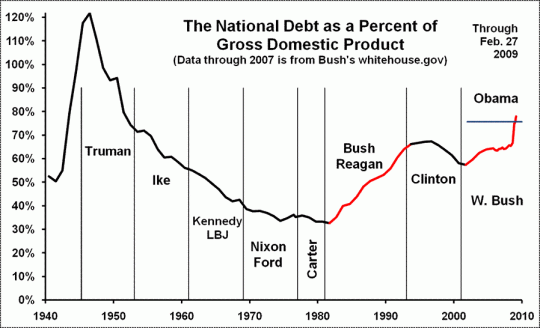
Seems that since 1980 Republicans have found a new meaning to the phrase “fiscally responsible” which ironically has nothing to do with being fiscally responsible. I also find it interesting that (according to this graph) is appears that George W Bush’s contribution to the national debt seems to have doubled in the final year of his presidency. Burn and run Bush. Burn and run. Turns out he wasn’t as immature and irresponsible as we’d thought. I really don’t know who he could have learned it from either? Hmm…
For those who don’t like to read: the fix.
I upgraded to Snow Leopard (OS X 10.6) from Leopard (OS X 10.5) last week and everything seemed to go off without a hitch, until…
I have a bluetooth, wireless, keyboard that I use for work. At some point in the past week, not initially, my keyboard started acting up. At first I didn’t think anything of it because the lady’s computer is also paired with the same keyboard and when the problem first occurred it was because the keyboard was connected to her computer, also on Snow Leopard, rather than mine. I ended up removing the keyboard from her bluetooth setup and re-pairing (no pun intended) the keyboard to my computer. Everything worked fine and I went through my day.
The next day, I found that my keyboard would not pair up again. WTF!? So I go through the process again, thinking maybe Laura and I did a keyboard swap or something and that was the problem. Re-paired, everything’s cool. Whatever. If it happens again, I’ll deal with it.
Finally, today, day 3, I start up my computer and the keyboard won’t connect. Immediately I try to re-pair the keyboard and suddenly the computer tells me there must be some compatibility issue. Thanks Apple. I have an Apple keyboard I’m using with an Apple Macbook Pro and I have a f***ing compatibility issue. You’d think they would make sure that bluetooth continued to work between upgrading from Leopard to Snow Leopard. Oh well.
So I resort to Google. And basically what I find is that I have to reset my System Management Controller (SMC). Do I know what an SMC is? No. Do I care? Not really… okay, so I do a little. Apparently the SMC handles a lot of the lower level operations performed by the computer like “the power button”. Sweet Apple. Okay, so what to do. You have to reset the SMC. To do this follow the steps specified here. Be sure to read through the process and select the procedure that matches your computer. Different laptops, desktops, etc. will have a different method for resetting the SMC.
All in all, it’s disappointing that Apple overlooked this issue. Seems too often that companies can be aware of an issue be keep it quiet for the majority of users that don’t use (in this case) bluetooth, while those that due have to spend have their day in frustration.
Dear Apple,
Don’t pull Quit pulling a Microsoft.
Your Friend,
Mr. Customer

If you use an Apple computer and/or the Adobe Suite — specifically the Flash IDE — you’ve probably encountered Apple and Adobe’s completely asinine use of your focus, or should I say hijacking of your focus.
Part 1:
I’ll start with Adobe because I just haven’t been liking them recently. Flash is a part of the Adobe Suite which includes Photoshop, Dreamweaver, InDesign, and Acrobat to name a few. Basically what Adobe has done is make it impossible to “hide” Flash while it loads. Now, one thing I find interesting in all of this, is that to my knowledge, out of all the Adobe Applications I own — Adobe’s Web Creative Suite — only Flash does this. What happens is that when you open the Application and as it is initializing, the loading screen will rest on top of all other programs you have open and running. Resulting in something like this:
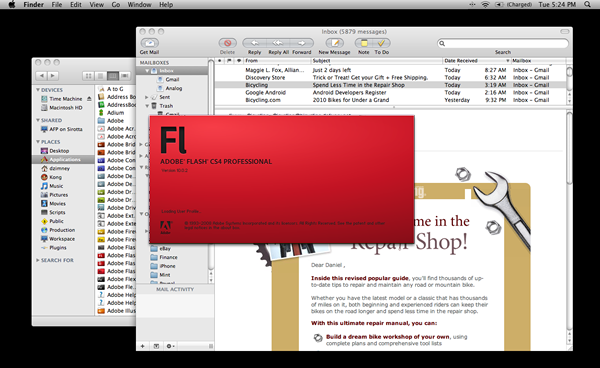
Adobe's asinine Flash loader
First off, I have to ask Adobe why? Why would it be important to have Flash steal the focus of my computer basically making it impossible to do anything else unless I work blind or carefully move my screens around the flash loader? What kind of user experience are you trying to deliver here? I’m already using the program and don’t need to be reminded of its magnificence as it’s loading. You’re an ass and need to get over yourself.
Part 2:
Apple’s part in the completely asinine use of focus is possibly, although definitely arguably, worse than that of Adobe. While Adobe completely hijacks your computer for a brief period of time is a completely dick move, Apple is just, well, stupid. You’ve probably noticed this before if you do a considerable amount of multitasking on your Apple computer and constantly have multiple Applications open at once. Somewhere at Apple, someone made the amazingly stupid decision to have Applications steal focus when they finish initializing. So lets say I’m looking at my email and open a link which in turn fires up Safari. As Safari is initializing I go back to my email and start a reply. In the middle of my typing Safari finishes initializing and steels my window focus cutting me off in the middle of my email. Thanks Apple, you complete ass.
Now this isn’t that big of a deal. The level of inconvenience is minimal, but there are two reasons this makes me want to choke Steve Jobs. First, to my knowledge, it is impossible to turn this nature off. I’ve scoured the Internets in search of a solution, a configuration setting, or some Apple or Shell script to run to change this. Nothing. If it was optional for Applications to behave in this way, I could deal with the idiotic default. Second, this behavior is totally and completely useless. It is only ever infuriating or otherwise useless. When would I ever want the program I’m loading to steel focus. Most people aren’t running defibrillator apps off their Apple computers that when fulling initialized need the program to take over for them immediately because otherwise someone might die. There has never and will never be a situation in which I will ever want an Application that does not currently have my focus to steel my focus just because it finished initializing. When I want to change my focus to a different application, I will do it. In the mean time do not hijack my focus. If this is an operating system bug that is difficult or impossible to solve, please forgive me and know that there is a great deal of interest in the community to have this problem resolved.